

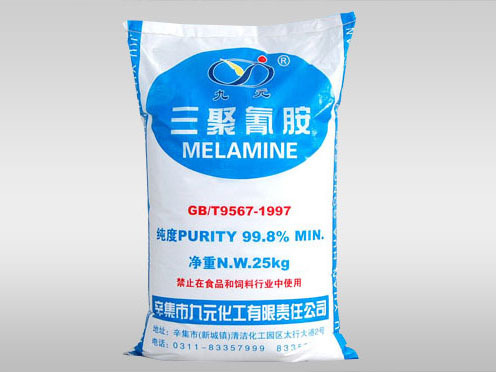
Name: Melamine
Melamine is an organic chemical intermediate widely used in industries such as coatings, pharmaceuticals, construction materials, papermaking, leather, and textiles. Melamine undergoes condensation with formaldehyde to produce melamine–formaldehyde resin (a type of amino resin). Melamine resin exhibits excellent properties, including heat resistance, water resistance, aging resistance, chemical reagent resistance, arc resistance, high gloss, high density, and high hardness, making it an important chemical raw material for industries such as plastics, coatings, wood products, papermaking, and textiles.
Classification:
Melamine
Keywords:
Description
Melamine — Jiuyuan Chemical
Integrity, Innovation, Quality, Competitive Value
TEL:400-678-6623
Melamine:
Molecular formula C3N6H6, molecular weight 126.13
Melamine: Molecular formula: C3N6H6; molecular weight: 126.13; appearance: white crystals or white powder; density: 1.573 × 10³ kg/m³ (at 25°C); melting point: 354°C. Melamine is soluble in glycerol, pyridine, hot ethylene glycol, ethanolamine, acetic acid, and formaldehyde, but insoluble in diethyl ether and carbon tetrachloride. Melamine is weakly basic, with a base dissociation constant KB = 1.0 × 10⁻⁹, and reacts with acids to form the corresponding salts. In acidic conditions and upon heating to boiling, melamine undergoes hydrolysis with water to yield dicyanuric acid diamide, cyanuric acid monamide, and cyanuric acid. At high temperatures or under conditions of insufficient ammonia partial pressure, melamine thermally deaminates to produce melem, melon, and meliam.
Uses of melamine——
Melamine is an organic chemical intermediate widely used in industries such as coatings, pharmaceuticals, construction materials, papermaking, leather, and textiles.
Melamine condenses with formaldehyde to produce melamine–formaldehyde resin, a type of amino resin. Melamine resin exhibits excellent properties, including heat resistance, water resistance, aging resistance, chemical resistance, arc resistance, high gloss, high density, and high hardness, making it an important chemical raw material for industries such as plastics, coatings, wood products, papermaking, and textiles.
Melamine resin is kneaded with fillers, pigments, and lubricants to produce thermosetting (amino) plastics. Its main advantages are light resistance, odorlessness, and ease of dyeing; it does not release toxic substances when exposed to water, does not carbonize at high temperatures, and exhibits excellent electrical insulation and mechanical strength. It can be used to manufacture various electrical or mechanical components, as well as heat-resistant containers and tableware for household use. Modified melamine-formaldehyde resins can be formulated into coatings such as baked paints that offer vibrant colors, durability, and high hardness. Melamine-formaldehyde resins are employed in the paper industry to produce shrink-proof and moisture-resistant papers; in the wood industry as adhesives or for manufacturing decorative panels; in the textile industry as finishing agents that prevent wrinkling, shrinking, fading, and color loss while enhancing wash resistance and maintaining garment stiffness; in the building materials industry as high-performance concrete superplasticizers; in the leather industry as tanning agents; and in the coatings industry as crosslinking agents, among other applications.

Decorative panels: can be manufactured as fire-resistant, earthquake-resistant, and heat-resistant laminated boards; vibrant, sturdy, and heat-resistant decorative panels; veneer sheets for furniture; and fire-, earthquake-, and heat-resistant materials for home decoration.

Coatings: After etherification with butanol or methanol, it serves as a crosslinking agent for high-grade thermosetting and solid powder coatings, and can be used to produce metal coatings as well as premium amino-resin decorative paints for vehicles and electrical appliances.

Molding powder: After processes such as compounding and pelletizing, it can be made into melamine plastic, which is dimensionally stable and stain-resistant. It retains excellent electrical properties even in humid conditions and can be used to produce white, impact-resistant householdware, sanitary ware, and porcelain-like tableware, as well as high-grade insulating materials for electrical equipment.

Paper: After etherification with diethyl ether, it can be used as a paper treatment agent.
CONTACT US
Add: No. 2 Taihang Avenue, Xinji Hi-tech Industrial Development Zone, Hebei Province
Code: 052372
Tel: +86-311-83357999 / 83359888
Fax: +86-311-83359888
Web: www.xjjyhg.com
E-mail: market@xjjyhg.com
Mobile web site
Copyright © 2023 Xinji JiuYuan chemical industry Co., Ltd. All Rights Reserved.
Powered by: 300.cn Shijiazhuang SEO